



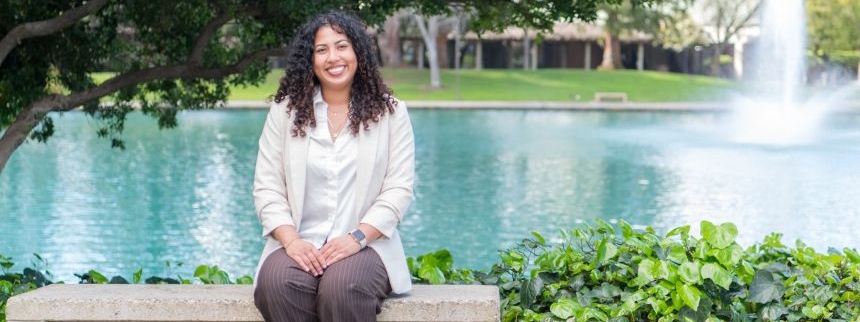
“No matter what they’ve done, I believe everyone deserves redemption,” says Cienna Silvia, program manager for Exodus Project, Solano. “They deserve the chance to ask for help and seek assistance,” she continues, referring to the formerly incarcerated who may opt to access Exodus Project services to help them reintegrate into community life.
Cienna’s heart seems naturally inclined to show mercy and compassion toward men and women who have been in jail or prison, or those about to be released. This mercy flows from her understanding that, despite their pasts, there can always be future stories filled with help and hope.
“My father was an addict, and he passed away from it when I was young,” Cienna shares, revealing the reason behind her dedication to this work. “That sparked my passion for helping people like him, and like my mom and sister and me,” she sighs, acknowledging a journey filled with pain and brokenness.
Cienna decided to earn a bachelor’s degree in criminal justice at San Francisco State University and landed an internship that influenced her career. Through Project Rebound, a university program that aids formerly incarcerated individuals in transitioning to higher education, Cienna began to see meaningful ways to help others.
“I really liked the work, and when I graduated at the end of 2020, I found Exodus Project in Sacramento,” she explains.
Rabbi Seth Castleman, the program director of the then-new Sacramento office, hired Cienna as a part-time office administrator. Over time, Cienna earned a master’s degree in social change and innovation, and became licensed as an Associate Clinical Social Worker (ASW). Having witnessed Cienna’s contribution to the Sacramento office’s growth, Seth promoted Cienna to the new Solano County position four years later.
The road out
“We’ve been open since February 2024,” Cienna says about the Fairfield office for Exodus Project. Both locations, Fairfield and Sacramento, operate under the Society of St. Vincent de Paul, Sacramento Diocesan Council, with the support and encouragement of the Roman Catholic Diocese of Sacramento.
“There was a need,” she explains due to the increase in phone calls and clients from Solano County reaching out to the Sacramento Office. But when a contract opportunity arose with the Solano County Sheriff’s Department, the Exodus Project team saw it as a call to broaden their services.
“It’s a little bit different than Sacramento,” Cienna compares, noting that “we focus on mental health” per the parameters and design of a Sheriff-funded grant.
“We have to address the mental health portion to successfully reintegrate people into the community,” she says, drawing on her experience and education. “We provide case management, ongoing support, and connection with agencies and resources.”
The Solano Exodus team consists of three case managers and Cienna; all trained in mental health crises and first aid.
Cienna estimates that up to 75 percent of clients served have struggled with mental health issues or trauma before incarceration. This number “skyrockets when you add drug-induced psychosis or drug-induced mental health conditions,” she explains, highlighting how vulnerable clients can be to falling back into the margins. Exodus Project can be, quite literally, a client’s road out of ongoing hardship, or worse, the risk of repeated offenses and incarceration.
A more recent contract with the Community Corrections Partnership (CCP) allows for “walk-in” clients to access services through Exodus Project, Solano. This casework includes individuals who may self-refer for services and are qualified by incarceration within the last year. They may be on probation or parole. All clients must reside in Solano County to be eligible for services through Exodus Project, Solano.
Case managers and mentors work with clients individually to help them find the resources they need as they re-enter community life. Whenever possible, they assist clients in rebuilding relationships and friendships. They also guide them to tangible resources.
Cienna appreciates the convenience of being physically located downstairs from Catholic Charities. She refers clients to them and to the Society of St. Vincent de Paul, Our Lady of Mount Carmel Conference. Food distribution, clothing thrift options, and county food bank resources are essential connections for clients. Exodus Project also assists with specialized appointments, counseling referrals, overcoming housing and employment barriers, identification, driver’s licenses, and many other routine living needs.
At just 27 years old, Cienna confesses, “People ask me, ‘How do you do this work?’ ‘How do you stomach it?’”
“At the end of the day, all of these people need support. They need help,” Cienna insists. “They need the guidance they didn’t get in their childhood, or even now,” she adds, stressing that judgment has no place in the work they do.
Visit the imprisoned
In a nuanced interpretation, visiting the imprisoned takes on a broader significance for the Exodus Project team and volunteers. The phrase, well-known from the verses of Matthew 25, and codified in the Church’s Corporal Works of Mercy, appears to encompass the Corporal and Spiritual Works of Mercy.
“There is absolutely a spiritual piece that guides this work,” Cienna affirms, mentioning the faith roadblock she faced herself while trying to break free from her childhood wounds.
“I remember a time when I used to be really angry with my religion and with God,” she recalls, reflecting on the years after her father’s death. Her family’s parish, St. Charles Borromeo in Sacramento, had always been central to her life, the place where she received her sacraments and shared her faith with extended family.
“I couldn’t understand why that happened to my family and me. I couldn’t understand how deeply I could hurt,” Cienna discloses about her own kind of emotional pain and imprisonment. “I think all this led me to where I needed to be, and God put me on this path,” she says.
“I needed to find my faith in God again, and he leads me to keep coming back every day,” Cienna attests, indicating that “a lot of people are similar to my story, asking ‘how can this happen to me? Why is this so hard? How could God do this to me?”
When clients bring up faith and spirituality, Cienna believes it can be an invitation for case managers and mentors to explore the topic. Many clients seek to reconnect spiritually and welcome mentors who might attend church with them, pray, or participate in a Bible study. Others value guidance toward faith-based support groups.
Mercy and redemption
Cienna continues to build a program that showers mercy, charity, and love on those it serves. Indeed, Exodus Project effectively translates acts of mercy into transformative second chances, to mercy and redemption.
“Building a program is not for the weak,” Cienna admits, describing the past two years as “very hard.” Some days she finds herself mentally and emotionally drained, on the brink of tears, if not flooded by them, for those beyond her reach, who slip, who fall. “I was built for this work,” she says with conviction, “my mind, my spirit, my soul.”
She is pleased with Exodus Project, Solano, so far. Numbers show that about 450 Solano clients have been served to date; clients who voluntarily seek to regain and transform their lives, slowly but surely.
“The next big step” will be establishing more mentors, Cienna says. She emphasizes the importance of the mentor-mentee relationship for each client’s success. She observes that many lack "a positive support in their life.”
“A lot of the people they have in their lives can be the reason they were in jail or prison,” Cienna posits, contrasting negative relationships with those of a trained mentor. “It’s astounding and inspiring to see the way a new connection can bring the good out of someone,” she conveys, suggesting that “even a stranger who believes in somebody” can inspire a client’s potential and self-esteem. A 16-hour mentor training series takes place in May and welcomes men and women of all faith backgrounds.
“It makes all the difference,” Cienna shares of the often-pivotal dynamic between mentors and mentees. These volunteers accompany clients on their journey toward wholeness, restoration and God’s redeeming grace.