



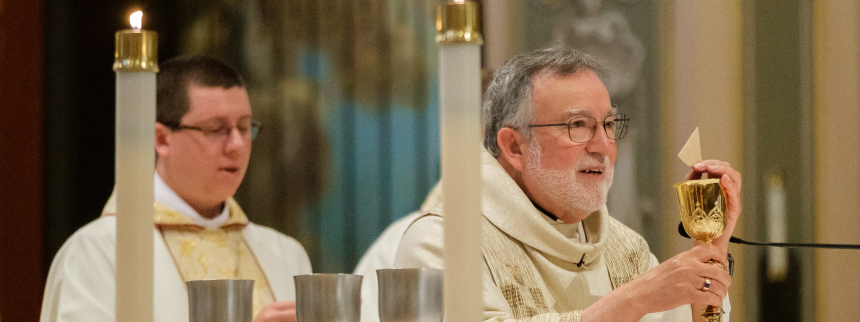
During the months of May and June, many proud parents bring their children to me after Mass announcing they have just graduated from a local high school or university and ask for a blessing. The young people, reluctant, rolling the eyes with embarrassment, are nudged forward by their eager parents so that I can bless them. I congratulate them, ask them where they are going to study or what degrees they obtained. They eventually relax, bow their heads, accepting that the blessing might be a good thing.
Another encounter that occurs with the coaxing of parents, is of a slightly different nature. The parents bring forward their son or daughter, the voices choking with conflicting emotions of pride and worry, asking for a blessing as their child prepares to enter the armed forces of the United States of America. With the most recent such meeting this past spring, my mind recalled the violent upheaval in the Strait of Hormuz and the deployment of many of our children into that murky quagmire. The young man was more eager to approach; grateful his parents had made the petition. Whatever the motives for choosing this path, the mood was sober, his eyes attentive to whatever encouragement or counsel I might impart.
There are many ways, young men and women, may choose a life of service. Certainly those who aspire to be teachers, nurses, doctors, social workers, or other helping professions convey a desire to serve others. Military service is another such path. At the same time, it acknowledges the troubling, belligerent nature of world affairs, demanding of any nation the means to protect and defend itself. For those who choose this path, the likelihood of the ultimate sacrifice looms large on the horizon. This is also true for first responders. Law enforcement and firefighters know this is part of the package.
Before beginning to offer Mass at a parish, I will gather with the ministers in the narthex of the Church for the entrance procession. If time allows, I peruse the bulletin boards and displays that busy the walls: Mass schedules, announcements of workshop or classes, pictures of catechumens preparing for baptism, and devotional materials for the faithful. Many parishes also keep a section for the photos of young men and women serving in the military: young faces in formal dress uniform, some dressed in fatigues standing alone or with fellow comrades in arms. Though deployed across the globe, the photos tether them to their families and communities in Northern California.
A number of priests have served as chaplains in the armed services. Others, having completed their military service, enlist for the priesthood. There is usually a story that accompanies such a transition. Something happened that shifted the mind or opened the heart, an epiphany that brought clarity despite the fog of war. An old adage holds there are no atheists in foxholes. The divine shepherd is always there for us. Sometimes the darkness makes his light easier to see. In the gospel of Mark, at the bleakest moment of Calvary, it was Roman soldier who saw clearly and exclaimed, “Truly this man was the Son of God!” (Mk. 15.39)
This past July, our Nation crossed the threshold of 250 years since a group of men gathered in Philadelphia, during the calamitous revolutionary war to expound their reasons to “dissolve the political bands which have connected them with another, and to assume among the powers of the earth, the separate and equal station to which the Laws of Nature and of Nature's God entitle them.”
Through the years that declaration was tested and tried by external foes as well as intense internal quarrels. Only four scores and seven years following that gathering, Abraham Lincoln, standing on the battlefield of Gettysburg, just two and a half hours from the hall where the American proposition began, pondered aloud, “We are engaged in a great civil war, testing whether that nation, or any nation so conceived and so dedicated, can long endure.”
The words of the Declaration of Independence, Lincoln’s Gettysburg Address, and other such formidable articulations of purpose throughout the course of American history, weigh on conscience not just because of their eloquence. They have been enfleshed in the blood and toil of those who served their country. Repeating the words of Lincoln, the “living and dead, who struggled here, have consecrated it, far above our poor power to add or detract.”
This covenant comes to mind when the parents nudge their children forward for the blessing before they leave the arms that held them and the homes that nurtured them.
The American proposition “that all men are created equal, that they are endowed by their Creator with certain unalienable Rights, that among these are Life, Liberty and the pursuit of Happiness” continues to be tried and tested. This is what history has shown us, but through the course of human events, we have also come to understand how precious this proposition is. Crafted by human hands and molded through the crucible of conflicts, we believe it is also a divine purpose entrusted to us. As we honor the memory of those who served and pray for those who serve us now, let us employ the freedoms given us to make the sacrifices that will bind us together as one nation, under God, indivisible, with life, liberty and justice for all.