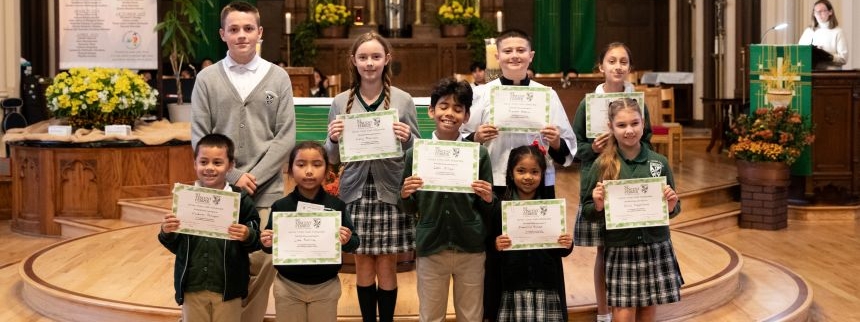
In 2019, Catholic schools in the Diocese of Sacramento implemented the Open Light Media educational program “Disciple of Christ – Education in Virtue.” Created by Dominican Sister John Dominic Rasmussen, the curriculum is based on the teachings of St. Thomas Aquinas and is meant to form Christian character through practice of the virtues and gifts of the Holy Spirit.
The goal of the virtue program is to identify what is “good” to students in a way they can understand. By showing students where virtue can be found and followed in daily life, the curriculum content makes sense to even the youngest of students.
The schools can work with the program in a variety of ways and adapt the lessons for different ages. More than just another lecture, the virtues program provides an opportunity for the students – and staff – to live out the virtues every day.
With an understanding of the virtues, each person in the school can recognize and celebrate how the virtues are lived by those around them every day. Students carry their excitement home, strengthening their families in living good, Christian lives. All students are learning about and living out the theological virtues of faith, hope and charity, and the cardinal virtues of prudence, justice, fortitude and temperance, as well as many related virtues.
Sacred Heart School, Sacramento
Using the materials provided by Open Light Media has made it simple for the administration and staff of Sacred Heart School to illuminate the lives of their students and families every day for the past three years.
“The program is intended to be infused in everything we do,” says principal Mercedes Hollcraft. “There is a virtue focus for each week. This is virtuous living that is infused in daily life. We change it around every year. We cover the virtues but don’t follow the same timeline.”
The program connects every grade and supports the goals of Sacred Heart. “My math coach says she felt like it gives everyone a common language,” Mercedes says. “We are all using the language and we are all aware. It is as easy to apply to an eighth grader as with a kindergartner. It’s really interesting to me how the teachers use it. It doesn’t feel forced at all. It’s our ultimate goal to raise virtuous children and be virtuous people. The virtues are aligned with our mission statement, which states that we are ‘rooted in Gospel values and centered in the Eucharist.’”
Adapting the program for students in different grades is simple. Teachers utilize different methods of discussion.
Kindergarten students watch daily videos that illustrate the virtue of the week while the Hallow app is integrated for the older students. Panther Virtue Cards are used by teachers and administration for all the students.
“The kindergartners just love the videos, they look forward to watching each day,” says Mercedes. “Panther Virtue Cards focus on the bigger virtues. Our Virtue Cards are utilized to acknowledge students when they are living out the virtues. During our weekly assemblies, our student council religion officer draws a few cards and calls out student names and the virtue for which they were recognized.”
Students’ understanding of virtues has made discipline in the school more positive.
“When a student hasn’t made a great choice, I ask them to go through the reflection sheet. It’s been really helpful to focus my discipline,” Mercedes says. “It gives them a moment to be thoughtful about their choices.”
The virtues may be the same each year, but the abundance of material provides different opportunities to reinforce each virtue with the students.
“Each year I see different ways the program is being lived out. It looks a little different year to year, but the program basically stays the same,” says Mercedes. “We take a little bit at a time. Then we start to incorporate those things that are going to be goals.”
Each year the teachers and administration work together to make a plan of how to integrate the virtue program school wide.
“This year it was bringing it into better connection with the school wide learning expectations, but how it looks in each classroom is up to the teacher. At faculty meetings, the teachers share what they are doing,” Mercedes says. “We have used the program to launch into a servant leadership program in junior high. We should be focused on social justice and service.”
The opportunities with the program provide both structure and flexibility for the school.
“The program is really rich,” says Mercedes. “It is important that it be utilized as a best fit for each school and each family. Take small bites of it and try it out. It’s intended to be lived, to be infused in how we live out our days. Virtues are meant to be lived, and we strive to affirm our students when they are living them out and making our school community more holy.”
St. Rose School, Roseville
Teamwork has brought virtues to the forefront at St. Rose School. At every grade, in administration and even at home, virtues are part of St. Rose.
So, not surprisingly, “Disciple of Christ – Education in Virtue” has a strong foundation at St. Rose.
“Success comes from the commitment that the faculty and staff have to this program,” principal Michael Garcia says. “We are using this to help develop our students into who they are when they leave us.”
“It’s the way the program is structured,” says religion teacher Catherine Durant. “It’s easy to implement. We’ve been very faithful as a school to implement the entirety of the program. Students recognize there is a uniformity across all the classrooms.”
“The culture of the school surrounds the virtues,” says Principal Michael Garcia. “The faculty and staff use the vocabulary. It’s really been infused in our culture. I send a weekly email focusing on the virtue of the week and I give some concrete examples. We’ve been able to use the program to catechize the parents.”
Each teacher can adapt the program to the needs of her students. Implementation looks different for second-grade teacher Gabriella Dutra and fifth to eighth-grade religion teacher Catherine.
“Every Monday we talk about what the virtue of the week looks like and sounds like,” Gabriella says. “Then we watch the video for the day and students draw pictures. Throughout the week we use the virtue card. We do faith families once a month.”
“I wanted to take it a little deeper,” says Catherine. “We still follow the virtue of the week. We discuss it in depth. For seventh and eighth grade, we incorporate virtues into all subjects. There are special activities. It gives them the language for understanding their behavior. I’m not just saying, ‘You shouldn’t have done this.’ Knowledge of the virtues changes the conversation into something more positive.”
What the students are learning about virtues doesn’t just stay in the classroom. Michael sees the fruits of the virtues with students outside the classrooms.
The positive reinforcement of the program across the years helps the students absorb more about the different virtues.
“We have the virtue tree (so) that we can go back to the virtues we studied in the past,” Gabriella says. “That’s how we connect back. The students learn the best from each other, when they see each other being respectful and being honest.”
“I like to tell the students it’s holy peer pressure,” says Catherine. “Now you can acknowledge the virtues in each other. It motivates them.”
Students are excited about the virtues program because they see the enthusiasm for the program in everyone at St. Rose. The younger students also see scenarios in the cartoons that mirror their personal experiences and that connection is important, Gabriella believes.
“The students are going to benefit because the team is all-in in doing the program,” Michael says.
“I breathe this program,” says Catherine. “I get really excited about the program and it rubs off on the kids. It’s very exciting because the virtues are applicable in life.”
While much of the program is geared toward students in the younger grades, the curriculum can be adapted for older students.
“I’ve been creating material for the middle school students,” says Catherine. “I want them to stay just as excited as the little kids. I’ve created a virtue wristband, and keeping the same structure but going deeper with the saint cards. I allow the kids to create their own scenario with a character using that virtue.”
Future applications planned will encourage personal responsibility and include a living document that will show students how they have grown in virtue and help them understand their strengths.
“My team is the best team I could possibly have and it’s shaping Catholic education in Roseville,” Michael says.
St. Vincent Ferrer School, Vallejo
St. Vincent Ferrer School has found implementing the virtue program in a variety of ways to be an asset for the school.
“More than a curriculum, Disciple of Christ – Education in Virtue is a way of life – a path to joy and fulfillment,” Principal Jaime Ignacio says. “Its lessons provide a clear framework that guides students of all ages in living virtuously each day. Over time, students begin to use the language of virtue naturally and grow as disciples of Christ. When we learn, live, and model virtue, it shapes every part of our lives – helping us become the very best version of who God calls us to be.”
The virtues program is part of the religion curriculum, but virtue discussions are also integrated with all subjects and in school culture.
“Teachers and staff, practice virtues and share their favorite one along with our family pictures,” says Spanish and Extended Care Director Malu Centeno. “Some classes have virtue journals, or pray a prayer related to the specific virtue of the week. We also incorporate them in school-wide projects, such as ‘Day of the Dead’ project, where we talk about the virtues of faith and hope. Our ‘Thankful for’ project, emphasizes the virtue of gratitude. In our school newsletter we share with our parents the virtue of the week and encourage them to help their students live out these virtues at home.”
St. Vincent Ferrer has implemented the Virtue in Practice (VIP) program that culminates as the eighth graders approach graduation.
“The graduating class reflects on their practice of the Catholic virtues. Each graduate chooses the virtue he or she practices best. The virtues are used as pivotal habits of correct thinking, the ordering of passions and moral conduct, aiming to perfect human living,” Eighth-grade homeroom Teacher Sean Tran says. “As disciples of Christ, the virtues enable students to view their lives and the world differently, providing meaning to living a well-ordered and disciplined lifestyle. Each graduate has discerned a virtue that they feel called to embody in our community to give witness to God’s great love for us. Therefore, the graduates are awarded a virtue medal at graduation, recognizing their accomplishments.”
Students receive a VIP ticket when they are observed practicing a virtue, which earns them prize passes and badges. Tickets are charted in each student’s virtue binder, helping to illustrate growth in virtues over time.
Prizes include passes for snacks, extra bathroom time, homework extensions and, on designated days, wearing clothing not part of the school uniform.
Virtue recognition also includes the awarding of badges – Cardinal Virtue, Tribes, VIP, Fun Run, Graduating and STAR.
“I love the virtues program,” says Malu. “I think it is making the students and us a little bit more conscious of what we do and how we conduct ourselves at school and in the community.”
“The program is helpful because it gives them a path to God, to lead holy lives,” says second-grade teacher Monica Sencil Prieto. “We recognize virtues that are easier for us, and others that we may struggle with. It is also helpful when we point out saints who may have struggled with some virtues and how they overcame their faults.”
Finding new ways to connect the students and staff with virtues is a priority.
“We hope to feature student-produced virtue videos made by the student council and to see our families use the virtues in their parenting,” says Monica. “As we continue to guide students to know about their faith, we would also like to incorporate the saints known for each virtue in every classroom, so we look to our models of faith and remember their struggles and triumphs with each virtue.”