



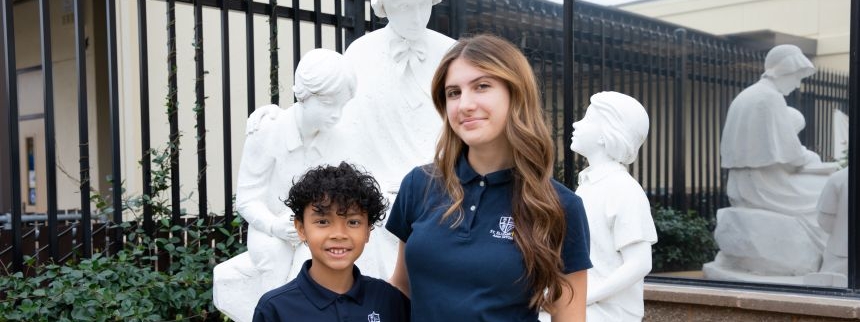
As she moves through her teenage years, experiencing the challenges of growing up, eighth grader Aubree Anderson of St. Elizabeth Ann Seton School in Elk Grove wants to “stay authentic to myself” and says, “I don’t think selfishly, but about how I can give up my time to benefit others.”
Her advice to her peers is “if you are strong in your faith, you won’t care what others think, but you will be true to yourself and your beliefs. Don’t let others pressure you into changing your beliefs or being someone you don’t want to be. And today that’s not always easy to do.”
For Aubree and some 100 other middle school students in her school, a new discipleship program developed by principal Marci Greene and middle school teachers might just be the ticket to help her and fellow students accomplish both spiritual and mental health and to see the connection between their Catholic faith and their everyday struggles.
Marci explains that the school developed its own program, based partially on “Arise: Made for Wholeness,” an interactive program from the Dominican Sisters of Mary, Mother of the Eucharist, which integrates the best of neurobiology with the call to virtue and holiness, leading adolescents to continue to build up their faith, and to set them up for social, emotional and academic success in high school and beyond.
In the Arise series, teachers use lessons and journaling with students to empower them to:
• Understand their minds and bodies in light of the best scientific research;
• Develop healthy habits and strong social-emotional skills;
• Navigate the workings of their growing minds and bodies in a mature and virtuous way;
• Experience the connection between growth and virtue and mental and emotional health;
• Look to the saints as relatable role models who shared their same struggles and became heroes of virtue;
• Strengthen their characters and develop their personal identities as sons and daughters of God;
• See how their Catholic faith can shed light on their most authentic questions and struggles.
Marci, who is in her ninth year as principal of the school, explains how the staff developed its own discipleship class, with teachers working with sixth to eighth graders divided into six groups equally by grade and assigned to one of the six middle school grade teachers. Each class has 17-18 students who meet Monday, Tuesday and Thursday after recess for 45 minutes. ”I believe Arise is meant to be grade specific at the beginning of each school day, so there is a bit of a difference in the intention of the Dominican Sisters, but this was the best way we could fit the discipleship class into our schedule,” she notes.
Last March, “middle school teachers met and we determined that there was a need for us to establish a stronger base for our virtue instruction and social-emotional development for middle school students, given the ongoing state of student needs,” Marci says. “I shared the presentation that was given by Dominican Sister John Dominic Rasmussen at a prior principals’ meeting, and her view that their students were not coming to school with their minds clear of the day-to-day needs, thus not ready to learn academically.”
Throughout the next five months, teachers took the weekly Arise lessons, meant to be taught daily over the course of the year and broke them down into a three-year program “married to our monthly school-wide virtue program,” Marci says. “These Arise lessons drive the topic of the month, and they are supplemented by the virtue of the month curriculum and other lessons developed by the teachers to form a solid understanding of the monthly topic. This is enhanced by executive function and study skills also needed for a strong academic foundation. Additionally, our counselor brings in lessons taught through the biblical version of Friendzy, a curriculum that focuses on a saying of the month that supports the virtue and the social-emotional learning exercises for the entire school.”
“By studying the virtues, I definitely try to examine my actions and what I can do better in the future,” says Aubree, who has been at St. Elizabeth Ann Seton since first grade. “I explain discipleship to others as the family you never knew you had until you have it. It’s like a bond that just shows up out of nowhere – you can walk in and not feel judged. I find myself having conversations with my teacher and I’m more comfortable and I’m thankful for that.”
Jordan Quiambao-Sims, a sixth grader who started at St. Elizabeth Ann Seton in pre-school, says Arise has helped him meet new students and “we learn how to grow closer to God, but not just by praying. It’s the little things each day that help us be positive, like making cards to show our gratitude or helping others. There are more ways than just praying that you can show gratitude to God.”
He adds: “I like when we get to share what we feel and not be scared to say it. I know everyone is here for me, that they can help me, and that there are others who we can talk to and lean on their shoulders. Then others speak up too and feel more comfortable about expressing their same feelings and fears.”
Becky Solie, an eighth-grade teacher who is in her 19th year at the school and in her ninth year teaching eighth graders, notes that in the past several years, middle school teachers noticed a trend in their students that “more kids had anxiety, were picking on each other for little things, and they couldn’t make a mistake without someone calling them out on it. They were missing some of their independent skills, such as taking initiative to talk to their teacher or following up on a missed assignment. We felt we needed to address all these issues, as well as to find a way to tackle the lack of empathy and lack of compassion for each other and also encourage self-reflection.”
One of the important lessons Jordan has learned in discipleship class is about neuroplasticity, the brain's ability to learn and adapt to new challenges. Becky notes that each lesson teaches students something about their own minds and bodies, a neurobiology “nugget” about
how the brain and nervous system work, as well as strategies to cope with the challenges of growing up.
“We are seeing a trend in low self-esteem among students, mainly due to social media use,” Becky says. “Our discipleship program helps build confidence among our students, so they can realistically look at social media and realize that’s not real life. Social media creates a false reality. We have some students who push through their struggles, but others come across an obstacle and just give up. We are here as a support to help them build what we always called ‘grit.’ In their groups, they know they are surrounded by other kids for support and building community.”
Marci says middle school teachers and students have embraced the Arise program wholeheartedly. The school has over 400 in pre-school through eighth grade.
What the discipleship class does “is give kids a chance to say they are not the only student struggling with a particular problem,” she says. “It gives them an open environment to have conversations you wouldn’t talk about only in homeroom or in academics. It’s a chance for them to interact on a different level or be able to mentor each other.”
In today’s culture, “failure, instead of being something they learn and grow from, has become very much a stumbling block and students can get past it. We are giving them the tools to have the grit and stamina that they can benefit from their entire lives,” Marci concludes.
After being in the discipleship class during its first semester, Aubree offers this advice to other teens: “Don’t be scared to be you, and to live your life to its fullest and be content, but remember to keep God in your life, because a life with everything is nothing without God. Be open to others, and when others try to talk with you about what they are going through, don’t turn them away or make it about yourself, and don’t try to ‘one up’ their opinions. Everyone is allowed to express opinions – sometimes they are nice, sometimes they are not. People are going to say what they are going to say and you can’t control them, but you can control you, so just try to be the best person you can.”
Jordan echoes Aubree partially in his assessment, noting that “if someone says something negative to you, don’t take it to heart. Be your own person and make your own decisions. Trust your gut and God, and don’t say negative things about yourself. You think what you think, and you decide your own values. If someone says something wrong to you it’s OK. Just breathe, and then once you are ready, you can talk to them. Don’t hold grudges against people. Everybody makes mistakes, and you just move on in your life and learn from them.”